Crystal Mining &
Processing
Journey from ancient mines to modern operations and discover how the world's most beautiful crystals are extracted from the earth and transformed into stunning specimens.
10,000+ Years of Mining
A History of Crystal Mining
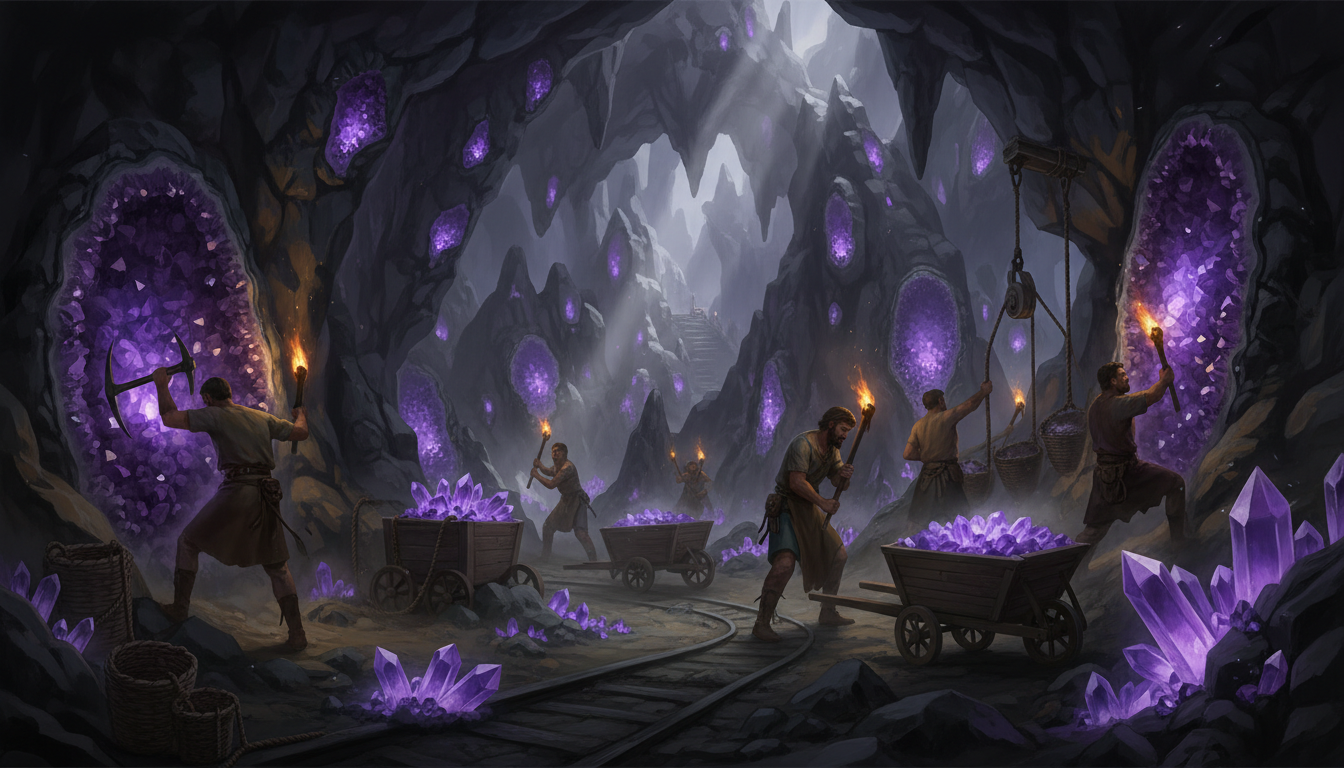
Humans have mined crystals and gemstones for over 10,000 years, from the earliest flint quarries of the Stone Age to the massive operations that supply today's global market. This ancient pursuit has shaped civilizations, sparked trade routes, and driven technological innovation across millennia.
Ancient Mining Civilizations
Ancient Egypt (3000 BCE)
Egyptians mined turquoise in the Sinai Peninsula and extracted lapis lazuli, emerald, and peridot. The famous Cleopatra Emerald Mines operated for over 1,500 years.
Roman Empire (100 BCE - 400 CE)
Romans operated extensive mining networks across Europe and North Africa, extracting amethyst from modern-day Germany and emeralds from Austria.
Medieval Period (500-1500 CE)
Bohemian garnet mines in Czech Republic and German silver mines yielded crystals alongside precious metals, supplying European royalty and cathedrals.
Colonial Era (1500-1900 CE)
European colonizers discovered vast crystal deposits in Brazil, Colombia, and India, establishing mines that continue operating today.
Crystals That Shaped History
Certain crystals drove trade and exploration throughout human history:
Lapis Lazuli
Traded from Afghanistan to Egypt 6,000+ years ago—one of humanity's first long-distance trade goods.
Turquoise
Mined by Native Americans for 2,000 years. The Cerrillos mines in New Mexico are among the oldest in North America.
Jade
Central to Chinese, Mesoamerican, and Maori cultures. Jade tools and ornaments date back 7,000 years.
Amethyst
Once valued equal to diamonds until massive Brazilian deposits were discovered in the 1800s.
Obsidian
Volcanic glass traded across ancient Mediterranean and Mesoamerica for tools and weapons.
Emerald
Colombia's Muzo mines, discovered by the Spanish in 1537, remain the world's finest source.
Around the World
Major Crystal Mining Regions
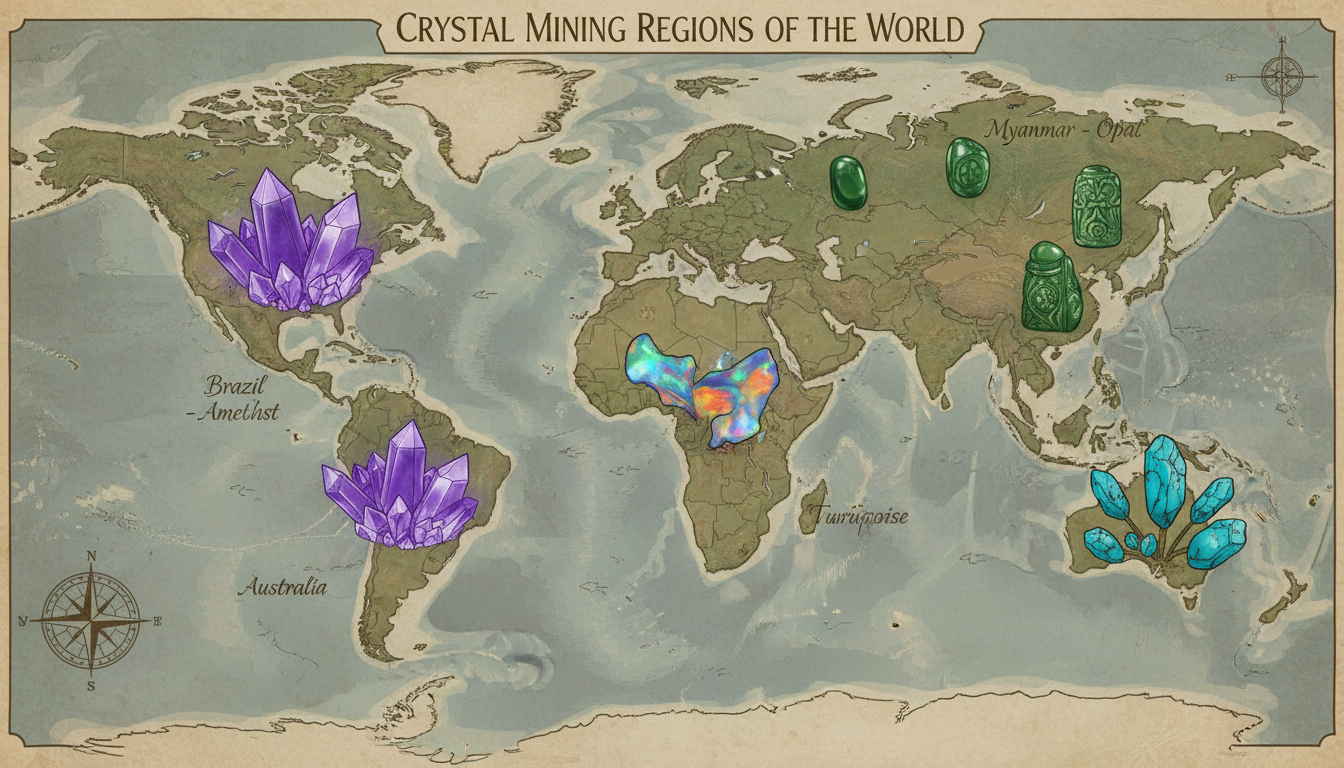
Crystal deposits are found on every continent, but certain regions have become famous for producing exceptional specimens. Understanding where crystals come from adds depth to any collection and helps identify authentic specimens.
Brazil
World's Largest ProducerBrazil dominates global crystal production, particularly from the mineral-rich states of Minas Gerais, Bahia, and Rio Grande do Sul. The country produces more quartz varieties than any other nation.
Madagascar
Island of GemstonesThis island nation produces some of the world's most vibrant and unique specimens. Madagascar's isolation created unique mineral formations found nowhere else on Earth.
United States
Diverse DepositsFrom the turquoise mines of the Southwest to the smoky quartz of Arkansas, America offers remarkable crystal diversity. Some locations allow public collecting.
Africa
Continental TreasuresFrom the Congo's malachite to Tanzania's tanzanite, Africa produces some of the world's rarest and most valuable gemstones, along with abundant collector specimens.
Other Notable Regions
India
Moonstone, Ruby, Sapphire, Garnet
Myanmar (Burma)
Jade, Ruby, Spinel, Peridot
Colombia
Emerald (world's finest quality)
Australia
Opal, Chrysoprase, Prehnite
Mexico
Fire Opal, Obsidian, Agate, Danburite
Pakistan/Afghanistan
Lapis Lazuli, Kunzite, Tourmaline
Russia
Charoite, Shungite, Seraphinite
Czech Republic
Moldavite, Bohemian Garnet
From Earth to Surface
Mining & Extraction Methods
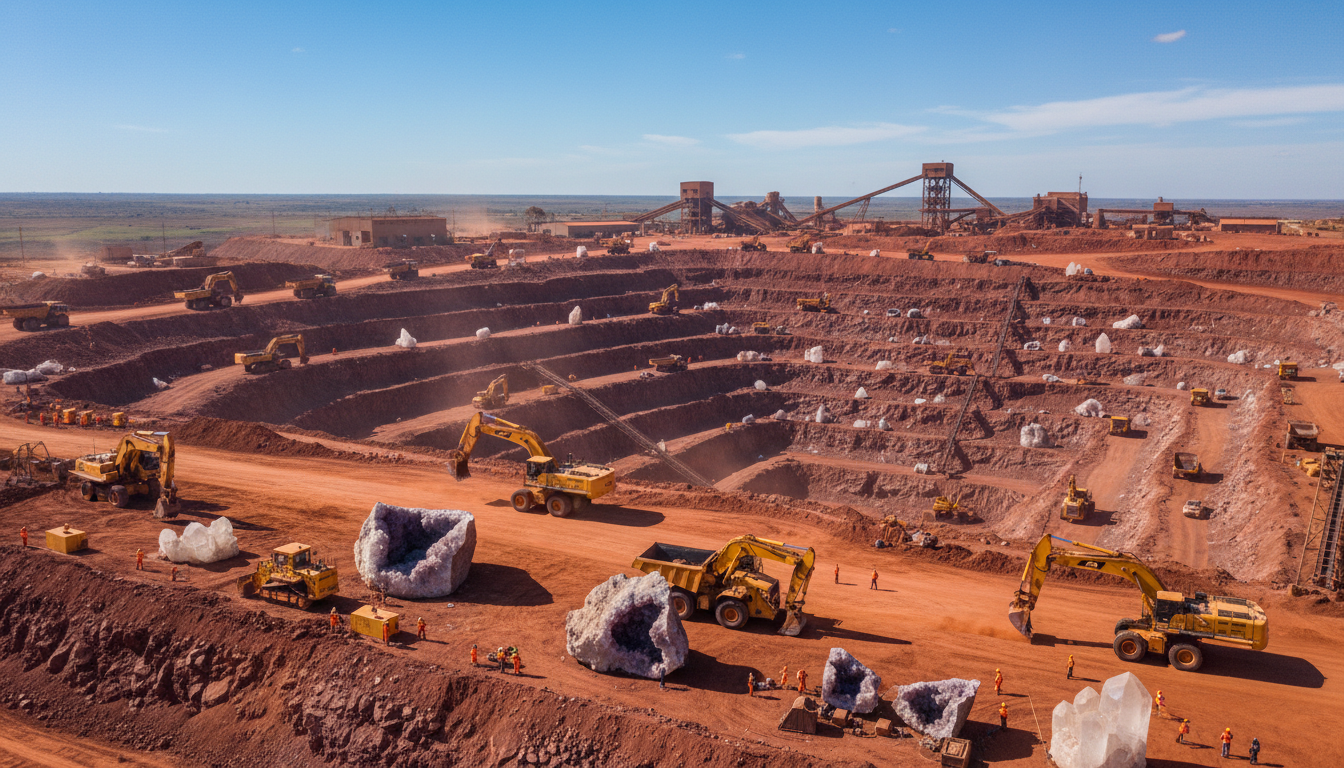
Crystal extraction ranges from individual prospectors with hand tools to massive industrial operations. The method used depends on the crystal type, deposit location, and desired specimen quality.
Primary Mining Methods
Open Pit Mining
Large-scale surface mining removes overlying rock to expose crystal-bearing veins. Used for massive deposits like Brazilian amethyst geodes and quartz. Efficient but environmentally impactful.
Common crystals: Quartz varieties, Topaz, Tourmaline
Underground Mining
Tunnels follow crystal veins deep into the earth. Essential for reaching deposits far below the surface. More labor-intensive but can produce museum-quality specimens.
Common crystals: Emerald, Tanzanite, Ruby, Sapphire
Artisanal Mining
Small-scale operations using hand tools. Often family-run in developing nations. Can produce exceptional specimens but with variable working conditions.
Common crystals: Most collector specimens
Alluvial Mining
Extracting crystals from riverbeds and sediments where they've been naturally deposited. Gems are separated from gravel through washing and sorting.
Common crystals: Sapphire, Ruby, Diamond, Spinel
Geode Extraction
Whole geodes are carefully removed from basalt or limestone formations. They may be sold whole, cut in half, or 'cracked' to reveal internal crystals.
Common crystals: Amethyst, Agate, Celestite
Careful Extraction for Collectors
High-quality collector specimens require delicate extraction to avoid damage. Professional miners use specialized techniques:
- Pneumatic tools — Air-powered chisels carefully separate crystals from matrix rock
- Diamond wire saws — Cut through surrounding rock without vibration damage
- Water jets — High-pressure water removes debris without scratching crystal faces
- Chemical dissolution — Acids dissolve surrounding calcite to reveal pristine crystals
- Hand picking — The finest specimens are selected individually by experienced miners
The Art of Transformation
Processing & Lapidary Arts

Once extracted, crystals undergo various processing steps depending on their intended use. Some remain as natural specimens, while others are transformed through the ancient art of lapidary—cutting and polishing gemstones.
From Raw to Refined
1. Cleaning
Raw crystals are cleaned with water, brushes, or mild acids to remove dirt, clay, and unwanted mineral deposits while preserving natural surfaces.
2. Sorting & Grading
Specimens are sorted by size, color, clarity, and quality. The finest pieces become collector specimens; others go to cutting or bulk sales.
3. Sawing
Diamond-blade saws cut crystals into rough shapes for further processing. Geodes are sliced to reveal internal crystal formations.
4. Shaping
Grinding wheels and carving tools shape crystals into desired forms—spheres, hearts, points, palm stones, or gem preforms.
5. Polishing
Progressive grits of silicon carbide, then fine polishes like cerium oxide or diamond paste create glass-like surfaces.
6. Faceting
For gem-quality material, precision faceting machines cut mathematically precise angles to maximize brilliance and fire.
Common Crystal Forms
Processing creates various forms, each with its own appeal and uses:
Natural Points
Unaltered crystal terminations, valued for their natural energy and formation
Tumbled Stones
Rough crystals polished smooth in rotating tumblers over weeks
Palm Stones
Flat, smooth shapes designed to fit comfortably in the hand
Spheres
Perfectly round shapes symbolizing completeness and unity
Towers/Points
Cut and polished into pointed obelisk shapes
Cabochons
Domed, polished shapes primarily used for jewelry
Faceted Gems
Precision-cut for maximum light reflection in jewelry
Carvings
Artistic sculptures from animals to sacred symbols
Slabs
Thin slices revealing internal patterns, often backlit
Treatments & Enhancements
Many crystals on the market have been treated to enhance color or appearance. Common treatments include:
- Heat treatment — Improves color in amethyst, citrine, tanzanite, and many others
- Irradiation — Creates smoky quartz, blue topaz, and enhances other colors
- Dyeing — Adds color to porous stones like agate, howlite, and jade
- Coating — Aura crystals are coated with metals for iridescent effects
- Oiling/Filling — Emeralds and other gems may be filled to improve clarity
Reputable sellers disclose treatments. Natural, untreated specimens typically command higher prices among collectors seeking authentic earth-formed crystals.
Responsible Sourcing
Ethical Considerations
As crystal popularity grows, so does awareness of mining's environmental and social impacts. Conscious collectors increasingly seek ethically sourced specimens.
Environmental Impact
Large-scale mining can cause deforestation, water pollution, and habitat destruction. Look for sellers who support reclamation efforts or sustainable practices.
Labor Conditions
Artisanal mining in developing nations may involve unsafe conditions or child labor. Fair trade and direct-source sellers offer better transparency.
Community Benefit
Ethical operations invest in local communities, providing fair wages, healthcare, and education to mining families.
Transparency
Reputable sellers can tell you where crystals originated. Be cautious of vague sourcing claims or suspiciously low prices.
Explore Our Crystal Collection
Now that you understand the journey from earth to collection, discover crystals from mining regions around the world. Each specimen carries the story of its origin.